


God In The Dock
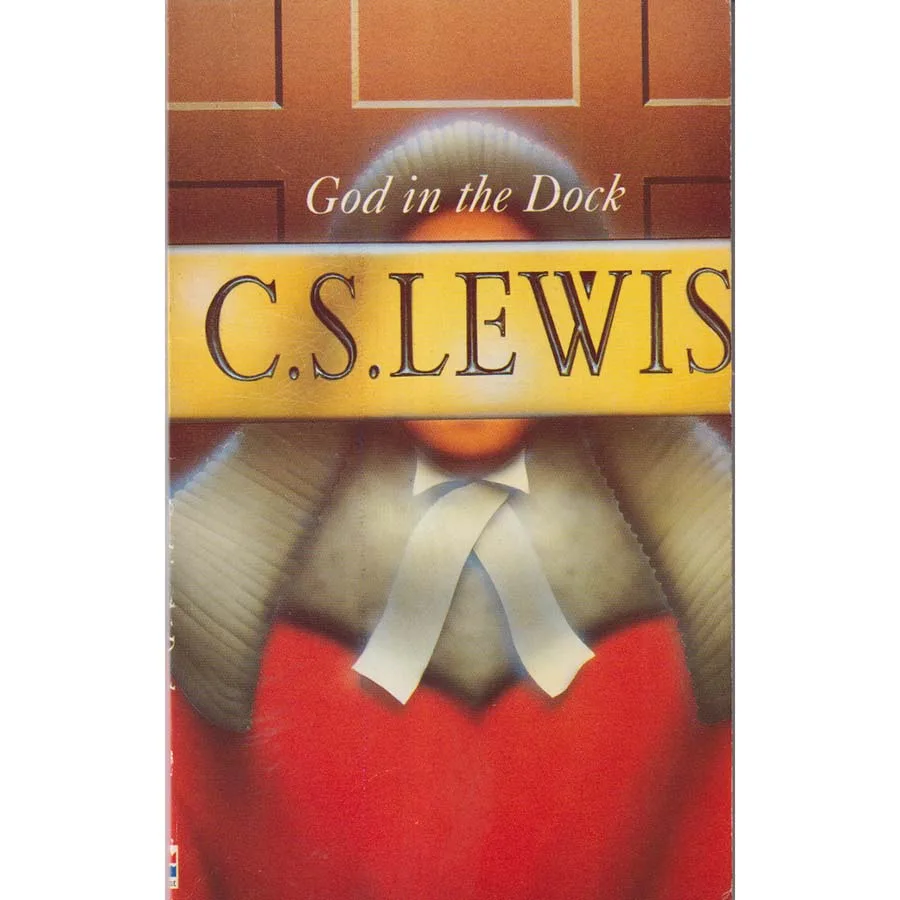
Publisher: Fount
Format: Paperback
ISBN: 9780006253716
There are few authors whose reputations rest simultaneously upon talking lions, wardrobe-based transport systems, medieval scholarship, literary criticism, Christian apologetics, and an apparently inexhaustible ability to win arguments long after their death. C. S. Lewis managed all of these with such ease that one suspects he would have regarded ordinary specialisation as a regrettable waste of time.
God in the Dock, first published after Lewis’s death and appearing here in a 1979 Fount edition, may possess one of the finest titles in twentieth-century religious writing. It immediately conjures the image of the Almighty being hauled before a modern tribunal, forced to explain Himself to an increasingly sceptical jury armed with notebooks and strongly worded questions. The irony, of course, is that Lewis believed modern society had quietly reversed the traditional relationship. It was no longer humanity on trial before God, but God on trial before humanity.
This collection gathers essays, talks, articles, and reflections covering theology, morality, culture, literature, prayer, belief, doubt, and the peculiar condition of being a Christian in the modern world. Lewis approaches these subjects with the irritating habit of being both intelligent and readable. Many writers achieve one or the other. Lewis managed both, which explains why his books remain in print while countless more fashionable contemporaries quietly disappeared into academic footnotes.
What makes the collection so enjoyable is Lewis’s refusal to write like a man trying to impress a seminar room. He writes as though he is attempting to explain things clearly. This sounds simple, but it is a surprisingly rare literary talent. Whether one agrees with his conclusions or not, there is immense pleasure in watching a mind at work that values clarity above obscurity and argument above jargon.
The essays themselves range widely. One moment Lewis is discussing profound theological questions; the next he is dismantling a fashionable intellectual assumption with the literary equivalent of a polite but devastating raised eyebrow. He had a gift for identifying weaknesses in arguments that others had accepted without question, then exposing them in prose so straightforward that readers sometimes fail to notice how much intellectual heavy lifting has just occurred.
From a modern perspective, the book is doubly fascinating. Not only does it offer Lewis’s thoughts on faith and culture, but it also provides a window into the concerns of the mid-twentieth century. Some debates have changed dramatically since then. Others have remained so remarkably similar that one occasionally wonders whether society has simply been holding the same argument in different clothing for the last hundred years.
There is also something wonderfully reassuring about Lewis’s tone. He never sounds panicked. He never sounds desperate. He sounds like a man who has spent a great deal of time thinking about difficult questions and is perfectly happy to continue doing so. In an age increasingly fuelled by outrage, certainty, and social media declarations typed at alarming speed, this measured confidence feels almost exotic.
As a physical object, this 1979 Fount edition is a pleasing representative of an era when religious publishing still believed serious ideas deserved serious books. It sits comfortably on a shelf among theology, philosophy, literary criticism, or general non-fiction, refusing to fit neatly into any single category.
Condition-wise, this copy is described as Very Good, which means it has survived nearly half a century with admirable composure. It remains a handsome, highly presentable copy, ready to accompany readers into discussions of faith, doubt, reason, morality, and the occasional intellectual ambush.
Whether you are a committed believer, an interested sceptic, a Lewis enthusiast, or simply someone who enjoys encountering first-rate prose applied to big questions, God in the Dock remains an immensely rewarding collection. Thoughtful, provocative, witty, and remarkably accessible, it demonstrates why C. S. Lewis continues to attract readers decades after his death.
Exactly the sort of intelligent and slightly dangerous book that Crappy Old Books delights in rescuing from the shelves and placing back into circulation, where it can continue starting arguments in the most civilised possible manner.
Keep browsing: See more Religion books Other books by CS Lewis
